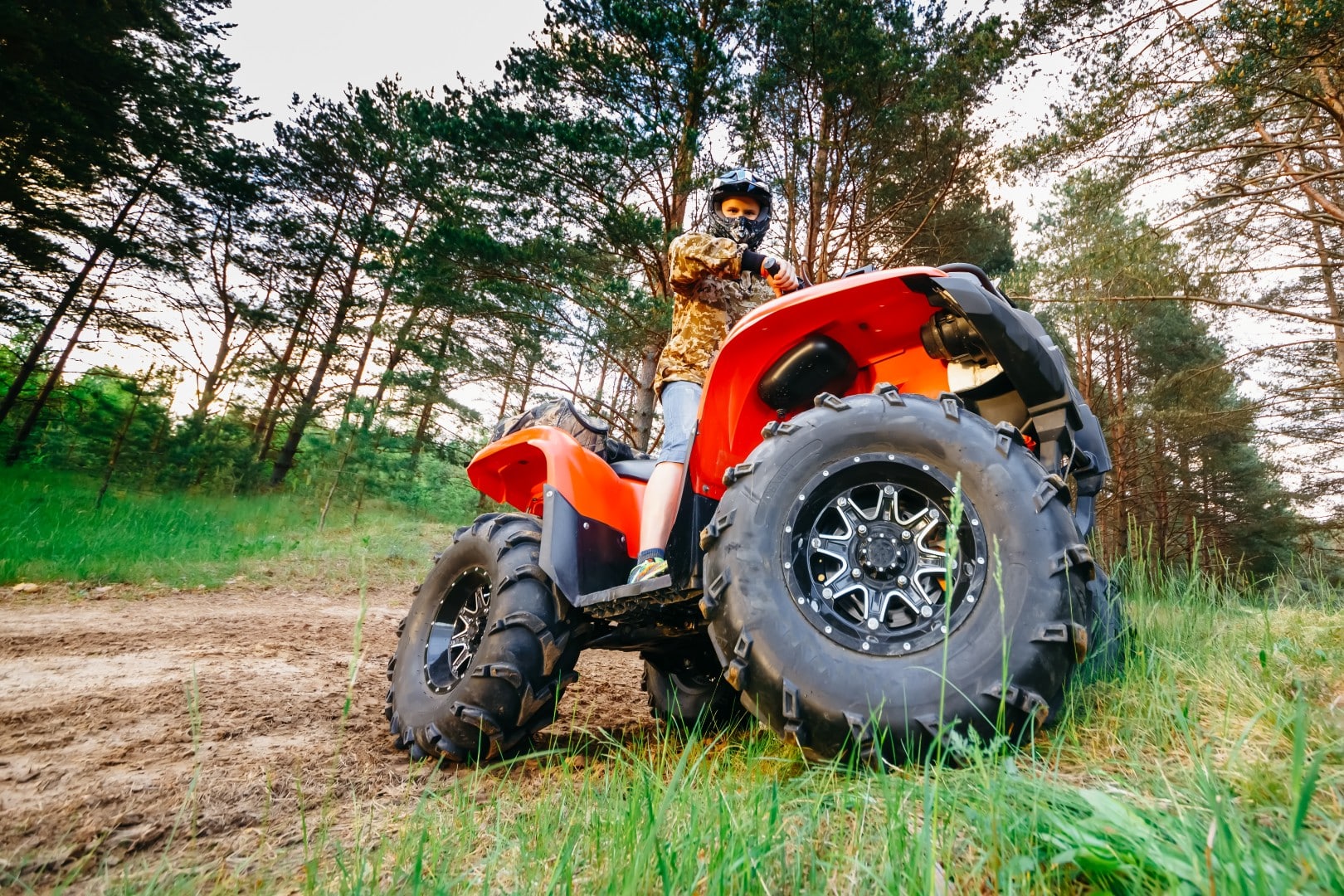
You’d think “what PSI for my ATV” has one answer. It doesn’t, and that’s not a dodge. The right ATV tire pressure depends on your machine, your tires, your load, and the number your manufacturer actually published. Check the owner’s manual or the tire-pressure label on the ATV before adjusting anything.
The manufacturer’s specified cold tire pressure. Not a chart, not what your buddy runs. That number lives in the owner’s manual or on a label on the ATV itself, model-specific and accounting for your tire size, rim, and load capacity.
Cold matters here. It means the tire hasn’t been ridden recently, because heat from use raises pressure. A post-ride reading isn’t the baseline the spec was written for, so check before you head out, not after.
Position matters too. Front and rear don’t always run the same PSI, and some ATVs split center and rear as well. A Polaris Sportsman 570 6×6, for example, specifies 7 PSI front and 10 PSI for center and rear. An Arctic Cat Alterra 500 runs 5 PSI across all four positions. Different machines, different specs, same basic job description. On a machine like the 570 6×6, running equal pressure across all positions isn’t following spec. It’s just simpler.
A tire running that low can deform over roots, rocks, and uneven surfaces rather than bouncing off them. Lower pressure spreads the contact patch wider, which improves flotation on soft ground and low-speed traction where a stiffer tire loses grip. That’s the reason ATV manufacturers publish specs most car owners would consider dangerously flat.
That’s not a green light to go lower than spec. Dropping below the manufacturer’s number can affect steering and handling, raise the risk of bead-related problems, and produce wear patterns the tire was never meant to develop. A low factory specification is intentional. Running below it for reasons the manufacturer hasn’t approved is a different matter.
At single-digit PSI, a few pounds in either direction is a meaningful percentage of the total, which is why Polaris warns in Sportsman documentation that improper tire pressure or overloading can cause loss of control. The numbers are small, but the margins are too.
Run the wrong pressure long enough, and it shows up in the rubber. Over-inflation concentrates wear down the center of the tread; under-inflation chews the edges and can stress the sidewall over time. Either way, handling changes before the wear becomes obvious: the ATV may push wider in turns, feel vague on loose terrain, or lose the planted feel it had at the correct spec. Knowing when tire replacement makes more sense than repair is worth understanding well before you need that answer on the trail.
Terrain influences setup thinking, but it doesn’t override manufacturer specs. Some riders drop pressure in soft mud or wet sand to spread the contact patch wider, and that’s a common practice on certain surfaces, though it’s a deliberate deviation, not a general recommendation. Approach it with a clear sense of your specific machine’s limits, because going too low can create bead retention problems that outweigh any traction gained.
Load is where things get more interesting, because manufacturers don’t all approach it the same way. The 2017 Can-Am Outlander 570 series operator’s manual builds load-dependent pressure tiers directly into the documentation: 7 PSI under a 132 kg load threshold, 10 PSI above it. Polaris, by contrast, publishes a fixed cold tire pressure alongside a separate maximum payload capacity, treating the two numbers as independent limits rather than a sliding scale.
The practical takeaway is the same regardless of which approach your manufacturer uses: inflate to what the documentation says for your load condition, check that you’re within the stated payload limit, and resist the instinct to adjust PSI based on how much gear you’ve thrown in the bed.
Let the tires cool first, then find the manufacturer spec for your exact model. Remove the valve cap and use a low-pressure gauge calibrated for single-digit readings. Standard automotive gauges, including pencil types, aren’t calibrated for the range most ATV specs fall into, so a gauge rated to 60 PSI may not give you a meaningful reading at 5 or 7.
Add or release air in small increments, recheck each position, and replace the valve caps when you’re done. Dirt in an open valve stem can contribute to contamination and slow leaks, both easy to miss and easy to prevent.
If one tire consistently loses more pressure than the others, temperature alone is unlikely to explain it. Ambient temperature shifts affect all four tires at roughly the same rate, so an isolated drop points somewhere specific: a puncture, a faulty valve core, a damaged valve stem, a bead seating issue, or wheel damage.
Track down the source before adding sealant. Sealant can mask the symptom while leaving the underlying problem in place, and it’s not a substitute for repairing structural tire or wheel damage. A persistent leak that keeps coming back is worth a shop inspection sooner rather than later.
Two ATVs parked side by side can require genuinely different pressures, and neither is wrong. That range runs wide even across three major manufacturers:
| ATV Configuration | Manufacturer-Specified Cold Pressure |
| Polaris Sportsman 110 | 3 PSI front / 3 PSI rear |
| Polaris Sportsman 570 6×6 | 7 PSI front / 10 PSI center & rear |
| Certain Polaris Sportsman 850 configurations | 7 PSI front / 7 PSI rear |
| Polaris Sportsman XP 1000 | 10 PSI front / 10 PSI rear |
| Arctic Cat Alterra 500 | 5 PSI front / 5 PSI rear |
| Can-Am Outlander 570 (under load threshold) | 7 PSI front / 7 PSI rear |
| Can-Am Outlander 570 (over load threshold) | 10 PSI front / 10 PSI rear |
That spread, from 3 PSI on a youth Polaris to load-tiered specs on a Can-Am, is exactly why a single ATV tire pressure chart falls apart the moment someone’s machine doesn’t match the assumption. Same segment, same general use case, different manufacturers and configurations, and the numbers don’t line up. No shortcut changes that. Googling a number and rolling with it isn’t an ATV tire pressure guide. It’s a confident guess.
Start from your documented spec, measure cold, and recheck after seasonal changes. If a tire loses air persistently, wears unevenly, or your ATV starts handling differently than it used to, that’s when a powersports shop is the right next call.

